Dental implants consultation

industry research

Why dental implant quotes can range from $7,500 to $50,000+ and how they might be misleading you

Industry expert tips for understanding what you're actually being quoted for (most clinics don’t want you knowing)

Portrait of William Holmes

William Holmes

Last updated December 19th, 2025

You've probably seen prices ranging from suspiciously cheap ($7,500 for full mouth restoration) to surprisingly expensive ($50,000+). But how do you determine the difference? The truth is, most people are comparing apples to oranges without realising it. Here's what actually separates cheap, mid-range, and high-end treatments (and how to avoid getting ripped off).

Diagram showing implant and prosthesis components

Understanding the two parts

Implant vs. Prosthesis (and why this matters for pricing)

Here's what most people don't realise: When you get a "dental implant," you're actually getting two separate components:

  1. The implant post – The titanium screw that goes into your jawbone
  2. The prosthesis – The artificial teeth that attach to those implants

Many clinics deliberately blur this distinction to make their prices look competitive, then hit you with the real cost later (but that’s not all).

Dental prosthesis materials

Breaking down the prosthesis options

The three main materials (and why they're NOT equal)

PMMA prosthesis example

PMMA (plastic)

What it isMedical-grade plastic, similar to denture material. Cheap, but not long-lasting. What most Australian dentists are actually quoting for.

Price rangeAustralia: $40,000 - $50,000+
Overseas: $8,000 - $12,000

Why it’s cheap

  • Quick to manufacture
  • Lower material costs
  • Minimal lab time required
  • Can be produced in batches

The problems

  • Stains easily from food and drinks
  • Wears down quickly (typically needs replacement in 3-5 years)
  • Looks visibly artificial up close
  • Can crack or chip under normal chewing pressure
  • Not suitable for long-term use

Watch out forMany Australian clinics quote $40,000–$50,000 for "full mouth dental implants" – but that price is for acrylic. Once you're committed, they offer zirconia as a "$15,000–$20,000 upgrade" for "premium results."

Porcelain-fused-to-metal (PFM)

What it isPorcelain exterior layered over a metal base. Proven technology used since the 1980s, but now outdated and being replaced by better alternatives.

Price rangeAustralia: $45,000 - $60,000+
Overseas: $10,000 - $14,000

PFM prosthesis example

Why it’s affordable

  • More natural appearance than PMMA
  • Decent durability and stain resistance
  • Requires skilled lab technicians to layer properly
  • Traditional material most dentists are familiar with

The problems

  • Metal base can show through as a grey line at the gumline
  • Can chip or crack under heavy bite pressure
  • Not as biocompatible as metal-free options
  • Aesthetic compromises compared to zirconia
  • Your Australian dentist may need to manage the metal-ceramic junction if repairs are needed

The bottom lineBetter than plastic, but still outdated. If you're paying for permanent implants, make sure you're getting modern materials.

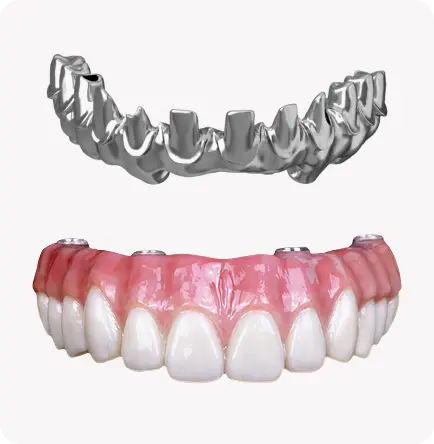
Zirconia titanium hybrid prosthesisZirconia detail diagram

Zirconia titanium hybrid (the gold standard)

What it isZirconia ceramic teeth reinforced by a titanium framework – combining zirconia's extreme hardness (known as "ceramic steel") with titanium's structural strength for unmatched durability. The new gold standard in modern dentistry.

Price rangeAustralia: $60,000 - $80,000+
Overseas: $15,000 - $19,000

Why it's the gold standard

  • Provides structural support and flexural strength
  • Handles high bite forces without bending or breaking
  • Perfectly biocompatible with bone and gum tissue
  • Fully biocompatible (no allergic reactions)
  • Precision-milled for optimal fit and longevity
  • More reliable long-term than single-material restorations
  • Will last 20+ years or a lifetime with proper care

The zirconia teeth

  • One of the hardest ceramics available (known as "ceramic steel")
  • Looks completely natural (no metal showing through)
  • Extremely resistant to wear, chips, and cracks
  • Tougher than natural tooth enamel
  • Won't stain, fade, or degrade over decades of use
  • Individual crowns make replacements easy

Why the hybrid worksWhen you combine titanium's strength with zirconia's extreme hardness, you get a restoration that can handle the full force of chewing while resisting surface wear better than any other option. The titanium takes the stress, while the zirconia protects against everyday wear and tear.

Dental implant components

Choosing quality implants

Budget to premium brands (and why this choice affects you back home)

Budget implant brands

Budget brands

Generic or lesser-known Chinese manufacturers can offer cheap implants, but here's the problem for Australian patients:

  • Most Australian dentists won't service unfamiliar brands
  • Replacement parts aren't available if something needs adjustment
  • No local warranty or support network
  • If you need work done back home, you may have to pay for complete replacement

Dentium: the smart middle ground

A globally recognised yet affordable brand that makes sense for Australian patients:

  • Globally recognised – used in 70+ countries
  • Established in Australia since 2005 – your dentist back home can source parts and service them
  • Proven track record – over 20 years of clinical research
  • High quality at a reasonable cost – hospital-grade titanium without the premium brand markup
  • Full documentation – every implant comes with a certificate of authenticity, QR code, and serial number for traceability
  • Warranty coverage that Australian dentists will honour
Dentium implant documentation

What the documentation means for youEach Dentium implant includes a manufacturer certificate with a unique QR code and serial number. Your Australian dentist can scan this to verify authenticity, access the implant specifications, and order compatible parts if you ever need adjustments. This traceability is critical for long-term care back home.

Premium implant brands

Premium options: Straumann & Nobel Biocare

These Swiss-made brands represent the highest tier in dental implants for good reason:

  • Decades of clinical research and proven longevity
  • The gold standard used by dentists worldwide
  • Widest network of compatible parts and servicing globally
  • Premium pricing reflects extensive R&D and brand reputation

While most quality overseas clinics can provide these premium brands, expect them to significantly increase your quote.

The bottom linePremium brands like Straumann and Nobel Biocare are excellent choices if budget allows. However, mid-tier brands like Dentium deliver proven, long-term results that Australian dentists can service at a more affordable price point.

Checklist document

What to look out for at any clinic

One question that protects you

Before you commit to any provider, make sure you can answer:
"What specific brand of implant and what type of prosthesis material am I being quoted for?"

If the clinic can't or won't put it in writing, that's your signal to walk away.

Every legitimate provider should transparently specify:

  • Implant brand, model, and documentation (certificates, QR codes, serial numbers)
  • Prosthesis material (PMMA, porcelain, or zirconia)
  • What's included vs. additional costs

Vague answers like "premium materials" or "high-quality implants" aren't good enough when you're making a $15,000+ decision.

Ask about warranty termsWho covers what, and for how long? What happens if you need work done back in Australia? Make sure warranty terms are in writing and realistic for someone living overseas.

Dental laboratory

Hidden advantage of an in-house laboratory

Here’s what most clinics can’t offer (overseas or IN Australia)

First, what is a dental lab?A dental lab is where prosthetic teeth are custom-made to fit over implants. Think of it as the workshop where technicians craft, shape, and finish the actual teeth you'll be chewing with. The quality of the lab's equipment, materials, and expertise directly impacts how well the restoration fits and how long it lasts.

In-house vs. outsourcedMost clinics send cases to external labs they don't control. A small number of clinics operate their own in-house lab on-site, giving them direct oversight of materials, quality, and timelines. Here's why that difference matters, using Thuy Anh Dental in Hanoi as an example of what to look for:

In-house lab quality control

1. Quality control you can trust

When labs are outsourced, clinics have no control over materials or craftsmanship. With in-house production:

  • Materials are verified and traceable (no questionable products from unknown suppliers)
  • The same team that's been working together for 10+ years handles your case
  • Direct communication between your dentist and the technicians who craft your teeth

2. Precision that affects longevity

Thuy Anh uses CAD/CAM technology with 5-axis CNC milling machines to create prosthesis frameworks:

  • Machine-milled frameworks fit more precisely than hand-cast ones
  • Better fit = longer lifespan, more comfortable chewing, less inflammation
  • Reduces risk of food trapping and gum issues
  • Custom abutments (the connector between implant and tooth) at a fraction of the market price
Precision milling equipment

The difference you can seeCompare a hand-cast framework to a machine-milled one under magnification, and the precision difference is dramatic. The problem? Most patients (and even some dentists) never see this until it's too late. When the framework doesn't fit precisely, you're more likely to experience complications down the track.

Warranty and lab process

3. Warranty you can actually use

This is where in-house labs really shine. After 10 years of operation, Thuy Anh has proven their commitment:

Unconditional prosthesis warranty. No bureaucracy.
Even if you lose your warranty paperwork, they'll honour it
Even if damage is from external causes
Fast resolution — usually same-day or next-day fixes

Real exampleOne patient came back and honestly admitted they'd used their teeth to open a beer bottle and broke the prosthetic tooth. Most clinics would deny the claim. Thuy Anh replaced it under warranty, no questions asked, no fees.

4. What this means when you return to Australia

Your Australian dentist receives:

  • Complete surgical records and digital files
  • Implant certificates with QR codes and serial numbers
  • Prosthesis specifications and materials list
  • Direct contact for the lab (if needed for adjustments)
Clinical documentation

If you need minor adjustments back home, your Australian dentist can work with your prosthesis. For any significant warranty work, Thuy Anh handles it, even years later.

Clinic experienceDental consultationDental procedurePatient results

Zenith Dental’s approach

Australia’s pathway to quality, transparent and affordable dental care in Hanoi, Vietnam

Transparency from quote to aftercareZenith partners exclusively with Thuy Anh Dental because they meet the standards Australian patients need:

  • ✓ Transparent quotes – Dentium implants as standard (Straumann/Nobel Biocare available), zirconia prosthesis specified
  • ✓ In-house lab – 10 years of operation, CAD/CAM precision manufacturing
  • ✓ Full documentation – Implant certificates, QR codes, digital records sent to your Australian dentist
  • ✓ Unconditional warranty – Prosthesis covered with no bureaucratic hassles
  • ✓ Australian aftercare – Your local dentist can service your work

Ready to understand exactly what you're getting?

Further reading

More articles & guides

Browse our full library of pricing breakdowns, materials explainers, and planning guides.